| |
| |
| |
| |
| |
|
DR. ARUN TRIVEDI |
|
| |
 |
... |
Sr. Scientist
LSS008, Biochemistry Division
Central Drug Research Institute
LUCKNOW- 226031
Lab Ext: 4343 |
| |
| |
| |
| HONORS & AWARDS |
- INSA Medal for Young Scientists-2013
- UP-CST Young Scientists Award 2012
- NASI Platinum Jubilee Young Scientists Award 2012
- ICSCC 2011 Young Investigator Award
- Jose Carerras foundation Fellowship
- 0.1% merit Certificate from CBSE in Social Studies
|
| AREA OF RESEARCH SPECIALIZATION |
| |
|
• |
Molecular biology of Acute Myeloid Leukemia (AML) and role of C/EBPalpha in cancer. |
|
• |
Unravelling role of ubiquitin signaling in cancer pathogenesis |
|
| |
| POST-DOCTORAL EXPERIENCE |
| |
• |
State Center for Cell and Gene Therapy, Martin Luther Univiersity (MLU), Halle, Germany |
Identification of C/EBPα multiprotein complex from CD34+ cells |
|
| |
| |
| CURRENT AREA OF RESEARCH
|
| |
|
• |
1. Understanding protein degradation pathways: Role of important E3 ubiquitin ligases in degradation of crucial transcription factors and signaling proteins.
E3 ubiquitin ligases regulate a variety of biologic processes by timely ubiquitination and degradation of many cell cycle and apoptosis- regulatory proteins. These E3 ubiquitin ligases transfer activated ubiquitin moieties in the uibiquitination process (Fig 1) from Ubiquitin E2 ligases to the substrates that are destined to be ubiquitinated. Since they timely regulate protein turnover, their controlled regulation is crucial for cell functioning. Recently, abnormal regulation of E3 ubiquitin ligases has been shown to be involved in cancer development. Therefore targeting E3 ubiquitin ligases for cancer therapy has gained increasing attention which is also evident from the recent approval of a general proteasomal inhibitor, bortezomib (Velcade, Millennium, MA), for the treatment of relapsed and refractory multiple myeloma. We intend to identify substrates of important E3 ubiquitin Ligases such as E6AP, Itch, Fbw7, TRAF6 and others which may provide better insight into the cancer pathogenesis and subsequent target based therapeutics.
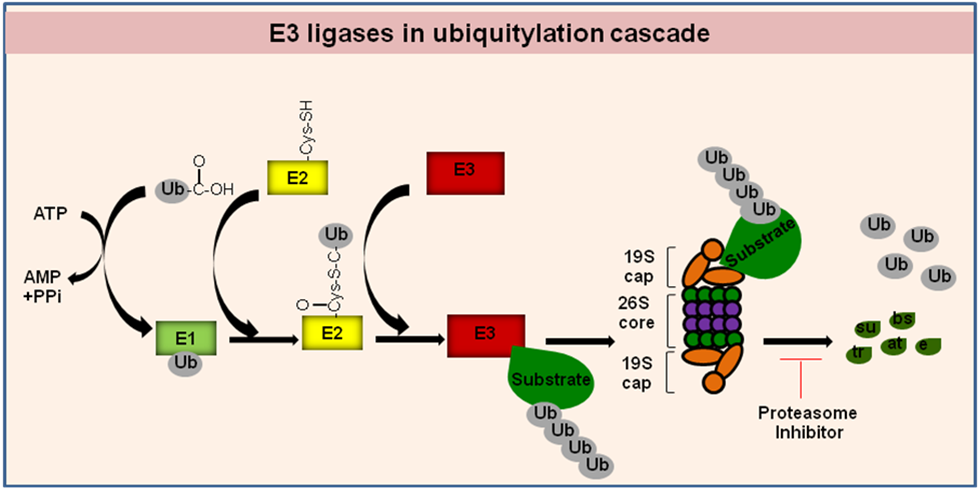
Figure 1: Ubiquitination Cascade
|
|
• |
2. Identification of interacting proteins of C/EBPalpha and their role in myeloid differentiation and leukemogenesis: A mass spectrometry based proteomics approach.
Transcription factors play a crucial role in myeloid differentiation and lineage determination. Tumour suppressor protein C/EBPα is a key regulator of granulocytic differentiation whose functional inactivation has become a pathophysiological signature of myeloid leukemia. Within hematopoiesis, full length C/EBPα, C/EBPβ and C/EBPε are expressed in monocyte, granulocyte and eosinophil lineage, However, C/EBPα is predominant isoform expressed in early myeloid cells. Studies with targeted disruption of C/EBPα gene demonstrated a selective block in differentiation of neutrophil while all the other blood cell types are present in normal proportions. This is so because; C/EBPα is required to activate GCSFr promoter and granulocyte specific genes. In addition, C/EBPα is also an important tumor suppressor as it regulates variety of cell cycle proteins such as Rb, E2F and cdks. Owing to its role in growth arrest and induction of differentiation, C/EBPα is at the center of attack in various cancers including myeloid leukemia. In myeloid leukemia C/EBPα is inhibited at various levels that are depicted in figure 2. We intend to identify the interacting proteins of C/EBPα using mass spectrometry based proteomics approach with aim to elucidate the mode of C/EBPα inhibition in myeloid leukemia by protein-protein interaction.
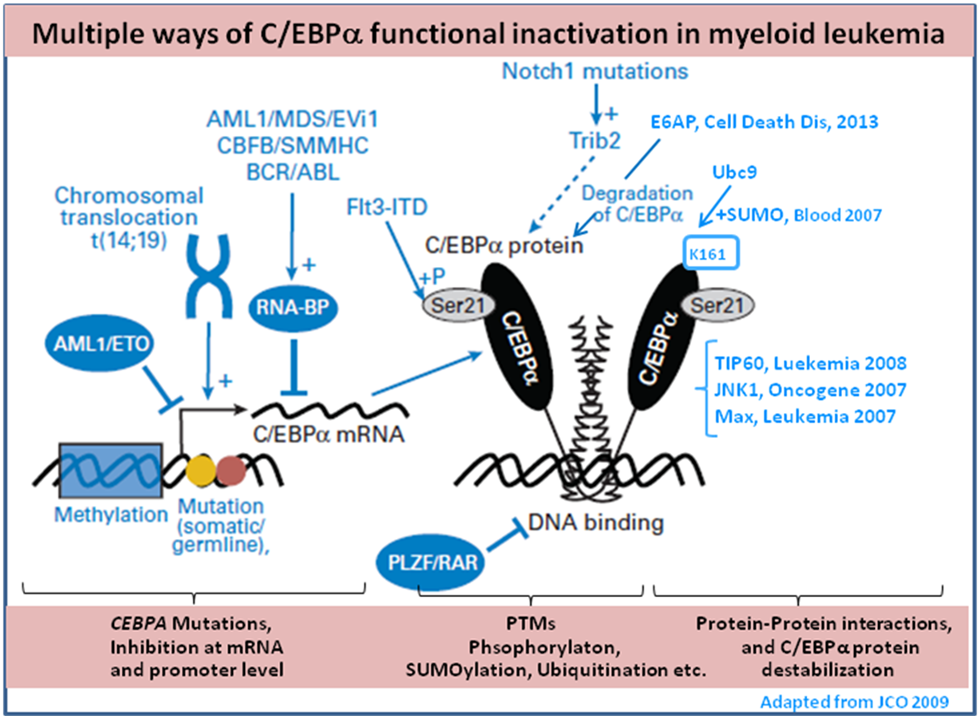
Figure 2: Multiple ways of C/EBPα inhibition in myeloid leukemia |
• |
3. Mechanism of action of anti cancer drugs/compounds using mass spectrometry based proteomics approach. |
• |
4. Screening of clinically validated compounds for their ability to induce differentiation and or apoptosis in myeloid leukemia cells. |
|
• |
5. Target based screening for proteasome inhibitors.
|
|
| |
| |
| LAB MEMBERS |
Yogesh Kumar, CSIR-JRF |
Gatha Thacker, CSIR-JRF |
Nidhi Shukla, CSIR-JRF |
Alumni |
Isha Kapoor, (PhD. Thesis Submitted) |
Savita Lochab NII-Young investigator at NII, New Delhi |
Jitendra Kanaujiya, Postdoctoral Fellow at University of Connecticut Health Center |
Dr. Pooja Pal (Teaching biotechnology at IET Lucknow) |
|
| |
| |
| SELECTED
PUBLICATIONS |
| |
2015 |
• |
E3 Ubiquitin Ligase Fbw7 Negatively Regulates Osteoblast Differentiation by Targeting Runx2 for Degradation.
Yogesh Kumar, Isha Kapoor, Kainat Khan, Gatha Thacker, Mohd. Parvez Khan, Nidhi Shukla, Jitendra Kumar Kanaujiya, Sabyasachi Sanyal, Naibedya Chattopadhyay and Arun Kumar Trivedi* J Biol Chem, November 5, 2015, doi:10.1074/jbc.M115.669531jbc.M115.669531.
|
• |
Proteomic discovery of MNT as a novel interacting partner of E3 ubiquitin ligase E6AP and a key mediator of myeloid differentiation¬. Isha Kapoor1, Jitendra Kanaujiya1, Yogesh Kumar1, T J Reddy3, Dr. M. L. B. Bhatt2, Naibedya Chattopadhyay4, Sabyasachi Sanyal1, Arun Kumar Trivedi1# Oncotarget-2015, In Press
|
• |
Prunetin signals via G-protein-coupled receptor, GPR30(GPER1): Stimulation of adenylyl cyclase and cAMP-mediated activation of MAPK signaling induces Runx2 expression in osteoblasts to promote bone regeneration.
Khan K, Pal S, Yadav M, Maurya R, Trivedi AK, Sanyal S, Chattopadhyay N. J Nutr Biochem. 2015 Aug 8. pii: S0955-2863(15)00188-6. doi: 10.1016/j.jnutbio.2015.07.021. [Epub ahead of print]
|
• |
Pathophysiological Mechanism of Bone Loss in Type 2 Diabetes Involves Inverse Regulation of Osteoblast Function by PGC-1α and Skeletal Muscle Atrogenes: AdipoR1 as a Potential Target for Reversing Diabetes-Induced Osteopenia.
Khan MP, Singh AK, Joharapurkar AA, Yadav M, Shree S, Kumar H, Gurjar A, Mishra JS, Tiwari MC, Nagar GK, Kumar S, Ramachandran R, Sharan A, Jain MR, Trivedi AK, Maurya R, Godbole MM, Gayen JR, Sanyal S, Chattopadhyay N.
Diabetes. 2015 Jul;64(7):2609-23. doi: 10.2337/db14-1611. Epub 2015 Jan 29
|
2014 |
• |
Orally active osteoanabolic agent GTDF binds to adiponectin receptors, with a preference for AdipoR1, induces adiponectin-associated signaling, and improves metabolic health in a rodent model of diabetes.
Singh AK, Joharapurkar AA, Khan MP, Mishra JS, Singh N, Yadav M, Hossain Z, Khan K, Kumar S, Dhanesha NA, Mishra DP, Maurya R, Sharma S, Jain MR, Trivedi AK, Godbole MM, Gayen JR, Chattopadhyay N, Sanyal S. Diabetes. 2014 Oct;63(10):3530-44. doi: 10.2337/db13-1619. Epub 2014 May 21.
|
• |
Thioaryl naphthylmethanone oxime ether analogs as novel anticancer agents.
Chakravarti B, Akhtar T, Rai B, Yadav M, Akhtar Siddiqui J, Dhar Dwivedi SK, Thakur R, Singh AK, Singh AK, Kumar H, Khan K, Pal S, Rath SK, Lal J, Konwar R, Trivedi AK, Datta D, Mishra DP, Godbole MM, Sanyal S, Chattopadhyay N, Kumar A. J Med Chem. 2014 Oct 9;57(19):8010-25. doi: 10.1021/jm500873e. Epub 2014 Sep 22.
|
• |
Synthetic FXR agonist GW4064 is a modulator of multiple G protein-coupled receptors.
Singh N, Yadav M, Singh AK, Kumar H, Dwivedi SK, Mishra JS, Gurjar A, Manhas A, Chandra S, Yadav PN, Jagavelu K, Siddiqi MI, Trivedi AK, Chattopadhyay N, Sanyal S. Mol Endocrinol. 2014 May;28(5):659-73. doi: 10.1210/me.2013-1353. Epub 2014 Mar 5.
|
2013 |
• |
Amino acids derived benzoxazepines: design, synthesis and antitumor activity.
Dwivedi SK, Samanta K, Yadav M, Jana AK, Singh AK, Chakravarti B, Mondal S, Konwar R, Trivedi AK, Chattopadhyay N, Sanyal S, Panda G. Bioorg Med Chem Lett. 2013 Dec 15;23(24):6816-21. doi: 10.1016/j.bmcl.2013.10.013. Epub 2013 Oct 11.
|
• |
E3 ubiquitin ligase Fbw7 negatively regulates granulocytic differentiation by targeting G-CSFR for degradation. Savita Lochab, Pooja Pal, Isha Kapoor, Jitendra Kumar Kanaujiya, Sabyasachi Sanyal, Gerhard Behre, Arun Kumar Trivedi, BBA-Mol Cell Res 2013, In Press.
|
• |
E3 Ubiquitin Ligase E6AP Negatively Regulates Adipogenesis by Downregulating Proadipogenic Factor C/EBPalpha.
Pal P, Lochab S, Kanaujiya JK, Kapoor I, Sanyal S, and Trivedi AK. PLoS ONE (2013); 8(6): e65330. doi:10.1371/journal.pone.0065330, [Epub ahead of print] |
• |
E6AP, an E3 ubiquitin ligase negatively regulates granulopoiesis by targeting transcription factor C/EBPα for ubiquitin mediated proteasome degradation. Pooja Pal, Savita Lochab, Jitendra Kumar Kanaujiya, Isha Kapoor, Sabyasachi Sanyal, Gerhard Behre, Arun K Trivedi , Cell Death and Disease 2013, [Epub ahead of print]. |
• |
Proteomic identification of Profilin1 as a co-repressor of Estrogen receptor alpha in MCF7 breast cancer cells
Jitendra Kumar Kanaujiya, Savita Lochab, Isha Kapoor, Pooja Pal, Dipak Datta, Madan LB Bhatt, Sabyasachi Sanyal, Gerhard Behre, Arun Kumar Trivedi, Proteomics 2013, [Epub ahead of print] |
• |
Proteomic analysis of rosiglitazone and guggulsterone treated 3T3-L1 preadipocytes. Pal P, Kanaujiya JK, Lochab S, Tripathi SB, Sanyal S, Behre G, Trivedi AK.Mol Cell Biochem. 2012 Dec 30. [Epub ahead of print], |
| |
2012 |
• |
Proteomic identification of E6AP as a molecular target of tamoxifen in MCF7 cells. Savita Lochab, Pooja Pal, Jitendra Kumar Kanaujiya, Shashi Bhushan Tripathi, Isha Kapoor, Madan LB Bhatt, Sabyasachi Sanyal, Gerhard Behre, Arun K Trivedi, Proteomics. 2012 May;12(9):1363-77. |
• |
Chemokine receptor trio: CXCR3, CXCR4 and CXCR7 crosstalk via CXCL11 and CXCL12. Singh AK, Arya RK, Trivedi AK, Sanyal S, Baral R, Dormond O, Briscoe DM, Datta D.Cytokine Growth Factor Rev. 2012 Sep 15. doi:pii: S1359-6101(12)00071-8. 10.1016/j.cytogfr.2012.08.007. [Epub ahead of print] |
• |
Proteomics approaches for myeloid leukemia drug discovery. Kapoor I, Pal P, Lochab S, Kanaujiya JK, Trivedi AK.Expert Opin Drug Discov. 2012 Sep 13. [Epub ahead of print] |
2011 |
• |
Bile Acid Receptor Agonist GW4064 Regulates PPAR{gamma} Coactivator-1{alpha} Expression Through Estrogen Receptor-Related Receptor {alpha}. Dwivedi SK, Singh N, Kumari R, Mishra JS, Tripathi S, Banerjee P, Shah P, Kukshal V, Tyagi AM, Gaikwad AN, Chaturvedi RK, Mishra DP, Trivedi AK, Sanyal S, Chattopadhyay N, Ramachandran R, Siddiqi MI, Bandyopadhyay A, Arora A, Lundåsen T, Anakk SP, Moore DD, Sanyal S. Mol Endocrinol. 2011 Apr 14. [Epub ahead of print] |
• |
Medicarpin, a legume phytoalexin, stimulates osteoblast differentiation and promotes peak bone mass achievement in rats: evidence for estrogen receptor β-mediated osteogenic action of medicarpin. Bhargavan B, Singh D, Gautam AK, Mishra JS, Kumar A, Goel A, Dixit M, Pandey R, Manickavasagam L, Dwivedi SD, Chakravarti B, Jain GK, Ramachandran R, Maurya R, Trivedi A, Chattopadhyay N, Sanyal S. J Nutr Biochem. 2011 Feb 16. [Epub ahead of print] |
• |
2-D gel electrophoresis-based proteomic analysis reveals that ormeloxifen induces G0-G1 growth arrest and ERK-mediated apoptosis in chronic myeloid leukemia cells K562. Pal P, Kanaujiya JK, Lochab S, Tripathi SB, Bhatt ML, Singh PK, Sanyal S, Trivedi AK. Proteomics. 2011 Apr;11(8):1517-29. doi: 10.1002/pmic.201000720. Epub 2011 Feb 25. |
• |
Proteomic approaches in myeloid leukemia.Kanaujiya JK, Lochab S, Pal P, Christopeit M, Singh SM, Sanyal S, Behre G, Trivedi AK. Electrophoresis. 2011 Feb;32(3-4):357-67. doi: 10.1002/elps.201000428. Epub 2011 Jan 20. PMID: 21254132 [PubMed - in process] |
2010 |
• |
Synthesis and cytotoxicity evaluation of (tetrahydro-beta-carboline)-1,3,5-triazine hybrids as anticancer agents. Kumar R, Gupta L, Pal P, Khan S, Singh N, Katiyar SB, Meena S, Sarkar J, Sinha S, Kanaujiya JK, Lochab S, Trivedi AK, Chauhan PM. Eur J Med Chem. 2010 Jun;45(6):2265-76. Epub 2010 Feb 10. |
• |
Ectopic expression of hC/EBPs in breast tumor cells induces apoptosis. Pal P, Lochab S, Kanaujiya J, Sanyal S, Trivedi AK. Mol Cell Biochem. 2010 Apr;337(1-2):111-8. Epub 2009 Oct 23. |
• |
Proteomics of AML1/ETO Target Proteins: AML1–ETO Targets a C/EBP–NM23 Pathway.Arun Kumar Trivedi, Sheo Mohan Singh,Savita Lochab,Maximilian Christopeit,Wolfgang Hiddemann and Gerhard Behre. Clin Proteom 2010 Volume 6, Number 3, 83-91. |
2006-2008 |
• |
Proteomic Identification Of Histone Acetyltransferase TIP60 As a Coactivator Of Myeloid Transcription Factor C/EBPalpha” Bararia D, Trivedi AK, Zada AA, Greif PA, Mulaw MA, Christopeit M, Hiddemann W, Bohlander SK, Behre G. Leukemia. 2008 Apr;22(4):800-7 (IF: 9.5) |
• |
Multiple Ways of C/EBPalpha inhibition in Acute Myeloid Leukemia”
Trivedi AK, Pal P, Behre G, Singh SM. Eur J Cancer. 2008 Jul;44(11):1516-23. |
• |
C/EBPalpha S248A mutation reduces granulocytic differentiation in human leukemic K562 cells”.
Singh SM, Trivedi AK, Behre G. Biochem Biophys Res Commun. 2008 May 2;369(2):692-4. |
• |
Target proteins of C/EBP{alpha}-p30 in AML: C/EBP{alpha}-p30 enhances Sumoylation of C/EBP{alpha}-p42 via up regulation of Ubc9”. Geletu M, Balkhi MY, Peer Zada AA, Christopeit M, Anto Pulikkan J, Trivedi AK, Tenen DG, Behre G; Blood. 2007 Nov 1;110(9):3301-9 |
• |
Proteomic Identification of C/EBP-DBD Multiprotein Complex: JNK1 Activates Stem Cell Regulator C/EBPalpha by Inhibiting its Ubiquitination": Trivedi AK, Deepak Bararia, Christopeit M, Abdul A. PeerZada, Sheo M Singh, Arnd Kieser, Hiddemann W, Hermann M Behre, Gerhard Behre; Oncogene. 2007 Mar 15; 26(12):1789-801 |
• |
"Proteomics of Acute Myeloid Leukemia: Cytogenetic Risk Groups Differ Specifically in their Proteome, Interactome and Posttranslational Protein Modifications: Mumtaz Yaseen, Trivedi AK, Mulu Geletu, Abdul A Peer Zada, Maximilian Christopeit, Herman Behre, Gerhard Behre; Oncogene. 2006 Nov 9; 25(53):7041-58. |
• |
“Proteomic discovery of Max as a novel interacting partner of C/EBPalpha: a Myc/Max/Mad link”
Zada AA, Pulikkan JA, Bararia D, Geletu M, Trivedi AK, Balkhi MY, Hiddemann WD, Tenen DG, Behre HM, Behre G. Leukemia. 2006 Dec; 20(12):2137-46. (IF: 9.5) |
| |
|
|
|
| |
|