|
|
|
| |
Cancer
Biology and related Areas
|
 |
|
Cancer
Biology research in CDRI focuses on breast,
cervical, oral, and prostate and blood cancers
with the following objectives:
· Creation
of appropriate platform for interdisciplinary
collaborative research
· Creation
of knowledge base in Cancer Biology
· Lead
identification/optimization to obtain drug-like
molecules |
| |
| BASIC
RESEARCH |
• |
Studies on molecular mechanisms of chemo
resistance in breast cancers. |
• |
Molecular studies on redox regulation
in breast cancers (Figure-1). |
• |
Studies on genomic profiling of cancers
in North Indian population. |
• |
Proteomics
based therapeutic target validation
in breast cancer
(Figure-2). |
• |
Studies on molecular mechanisms of selective
estrogen receptor modulator action in
cancer cells. |
• |
Elucidation of anti cancer drug action
in patient derived primary cell culture
systems. |
• |
Studies
on identification of molecular targets
of anticancer drug action using yeast
as a model system |
|
|
| DRUG
DESIGH AND SYNTHESIS |
|
• |
Anti-cancer compounds based on rational
approaches of drug design including
CADD & virtual screening. |
|
• |
2D & 3D-QSAR based predictive models
for the design of novel anti-cancer
agents. |
|
• |
Natural product inspired scaffolds as
Anti-cancer agents. |
• |
Design of biologically active anticancer
peptides. |
|
| |
| SCREENING
AND DRUG DEVELOPMENT |
• |
In vitro cell based and high throughput
screening.
•
Ovarian Cancer, Breast Cancer, Oral
Cancer
•
Prostate Cancer, Cervical Cancer, Blood
Cancer |
• |
In vitro screening of drugs
in primary patient derived chemo resistant
cells. |
• |
Development of in vivo mouse
models for screening of active molecules. |
|
Figure-1
Studies on Redox Regulation in Carcinogenesis
|
|
| Aberrant Redox regulation
induces oxidative stress in the cellular micro
environment leading to modification of cell
signaling pathways and initiation of carcinogenesis.
Ongoing studies aim to understand regulation
redox pathways and their influence on cell
survival and carcinogenesis. |
| |
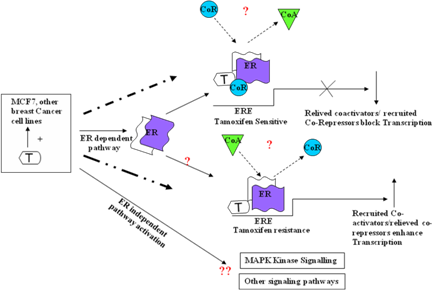
Figure-2
Proteomics based approach for therapeutic
Target validation in breast cancer
|
|
| Antibreast cancer
drug (T) induces Estrogen Receptor (ER) to
undergo a conformational change that targets
the receptor for interaction with both coactivators
(CoA=????) and corepressors (CoR=???). Unopposed
coactivators enhance transcription at specific
loci, leading to an increased agonist activity
and drug resistant phenotype. The increased
corepressor level blocks transcription and
maintains the drug-sensitive phenotype. In
addition other pathways (=????) may also be
activated/inhibited upon by drugs. The proteomic
based approach aims to validate novel drug
/therapeutic targets |
| |
| Significant
achievements |
• |
Patient
derived primary cultures for drug screening
developed. |
• |
FRET
assays for screening of small anti-cancer
molecules developed. |
• |
In vitro cell
based assays for screening of nuclear
receptors developed. |
• |
Proteomic screening
of anticancer agents standardized. |
|
| |
| Recent
Publications |
• |
GPS2 is required for cholesterol efflux
by triggering histone demethylation,
LXR recruitment, and coregulator assembly
at the ABCG1 locus. (2009) Jakobsson
T, Venteclef N, Toresson G, Damdimopoulos
AE, Ehrlund A, Lou X, Sanyal S, Steffensen
KR, Gustafsson JA, Treuter E. Mol Cell.
2009 May 14;34(4):510-8. |
• |
Breast cancer risk associated with polymorphisms
of IL-1RN and IL-4 gene in Indian women.
(2009) Konwar R, Chaudhary P, Kumar
S, Mishra D, Chattopadhyay N, Bid HK.Oncol
Res. 2009;17(8):367-72. |
• |
Staurosporine induces apoptosis in human
papillomavirus positive oral cancer
cells at
G2/M phase by disrupting mitochondrial
membrane potential and modulation of
cell cytoskeleton.(2009)Sarkar
J, Singh N, Meena S, Sinha S.Oral Oncol.
PMID: 19502099 |
• |
Centchroman induces G0/G1 arrest and
caspase-dependent apoptosis involving
mitochondrial membrane depolarization
in MCF-7 and MDA MB-231 human breast
cancer cells. ( 2008)Nigam M, Ranjan
V, Srivastava S, Sharma R, Balapure
AK. Life Sci. 2008 Mar 12;82(11-12):577-90 |
• |
Molecular iodine induces caspase-independent
apoptosis in human breast carcinoma
cells involving the mitochondria-mediated
pathway. (2006) Shrivastava A, Tiwari
M, Sinha RA, Kumar A, Balapure AK, Bajpai
VK, Sharma R, Mitra K, Tandon A, Godbole
MM.J Biol Chem. 2006 Jul 14;281(28):19762-71 |
• |
Mechanism of 4-HPR-induced apoptosis
in glioma cells: evidences suggesting
role of mitochondrial-mediated pathway
and endoplasmic reticulum stress.(2006)Tiwari
M, Kumar A, Sinha RA, Shrivastava A,
Balapure AK, Sharma R, Bajpai VK, Mitra
K, Babu S, Godbole MM.Carcinogenesis.
2006 Oct;27(10):2047-58. |
• |
Multiple ways of C/EBPalpha inhibition
in myeloid leukaemia. Trivedi AK, Pal
P, Behre G, Singh SM.Eur J Cancer. 2008
Jul;44(11):1516-23 |
• |
Proteomic identification of C/EBP-DBD
multiprotein complex: JNK1 activates
stem cell regulator C/EBPalpha by inhibiting
its ubiquitination.(2007) Trivedi AK,
Bararia D, Christopeit M, Peerzada AA,
Singh SM, Kieser A, Hiddemann W, Behre
HM, Behre G. Oncogene. (2007) 26(12):1789-801 |
• |
Isoniazid induces
oxidative stress, mitochondrial dysfunction
and apoptosis in Hep G2 cells.
(2007) Bhadauria S, Singh G, Sinha N,
Srivastava S. Cell Mol Biol 15;53(1):102-14. |
|
| |
| |
|
Cancer Biology Research Group |
|
| |
| |
| |
|
|
| |
|
website
copyright © Central Drug Research Institute.
All rights reserved.
No part of this should be Downloaded or used
in any way other than the non-commercial purposes
without prior permission of the Director,
CDRI. |
|
|
|
|
|